Research Accessories
Research accessories support work at the laboratory bench. This category currently focuses on bacteriostatic water, rather than a complete set of laboratory supplies. Start with the listing to check the available format, then read the notes below before treating any solvent as a match for a peptide. Accessories here are supplied for laboratory research only, not for human or veterinary use.
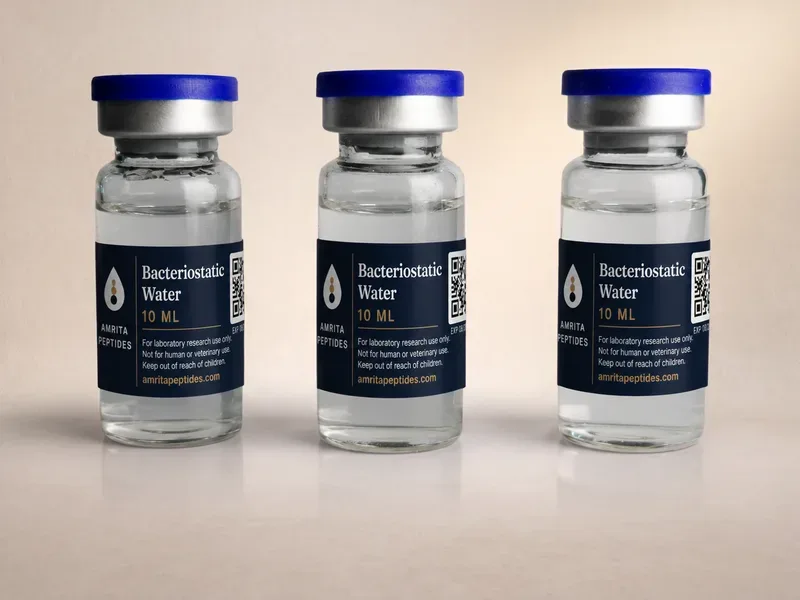
Bacteriostatic Water
Molecular formula: H2O + C7H8O
The water you mix peptide powder with. A little benzyl alcohol stops bacteria growing, so one vial lasts about four weeks after opening.
What bacteriostatic means
Bacteriostatic describes the inhibition of bacterial growth. It does not mean that a liquid can clean a contaminated sample or make an unsuitable preparation safe. A preservative is not a substitute for careful handling, clean equipment or a laboratory procedure that fits the work being done.
It also does not tell you whether the liquid is compatible with a particular research material. A solvent and a peptide need to be considered together, including any preservative and the conditions of the planned experiment. The fact that an accessory is sold alongside peptides is not evidence that it suits every peptide.
Check compatibility before quantity
Before deciding how much liquid is needed, check what the laboratory’s procedure requires. The solvent, preservative, concentration and container may all matter to the work. If a source names a different solvent, do not replace it solely because another liquid is easier to obtain.
The reconstitution guide linked below explains how to organise those checks. Reconstitution means adding a suitable liquid to a dried material; it is not a quality test. Material that dissolves or looks clear has not thereby been shown to have the expected identity, concentration, purity or freedom from contamination.
Keep three quantities separate
A liquid’s volume, a vial’s stated peptide amount and the final concentration are different pieces of information. Volume describes how much liquid there is. The stated peptide amount describes the material listed in a vial. Concentration connects an amount to a volume after preparation.
Confusing these quantities can create errors in a laboratory record. Write the units beside each number and keep the product identity attached. An accessory’s container size does not determine a suitable concentration for an experiment, and a shopping basket is not a preparation plan.
Handling and records matter after opening
Record the product label, receipt date, opening date and any preparation details required by the laboratory. Follow the applicable storage and handling procedure. Do not invent a universal period of use from the word bacteriostatic or assume that the same period applies to a mixture prepared with it.
The laboratory safety guide covers clean work areas, contamination precautions and traceable records. If a seal is damaged, the label is unclear or the handling history is uncertain, pause and resolve that uncertainty through the laboratory’s procedure. A photograph may document what arrived, but it cannot establish sterility. Keep ordering questions separate from scientific suitability: the product page shows the listed option and price, while compatibility must be established for the actual work.
Related research and guides
Background reading for this research area, from our published guides and blog.
How to Reconstitute Research Peptides in the Lab
A laboratory guide to solvent compatibility, nominal concentration, documented reconstitution steps, and deviation troubleshooting for research peptides.
GuidePeptide Handling & Lab Safety: Aseptic Bench Handling
A laboratory guide to peptide hazard assessment, aseptic bench handling, engineering controls, incident response, labelling, storage, and waste segregation.
For laboratory research use only. Not for human or veterinary use.