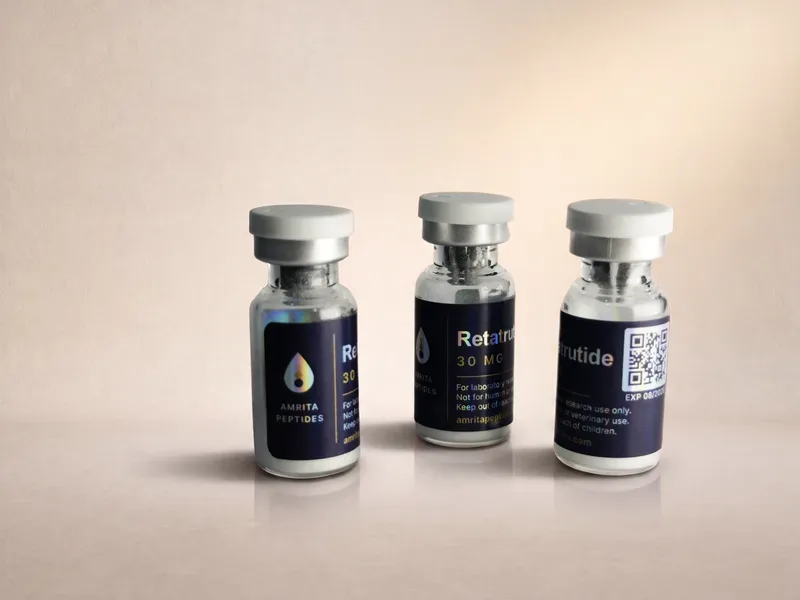
Retatrutide
Molecular formula: C221H342N46O68
The newest of the weight-research peptides: one molecule that works on three appetite-and-metabolism receptors — GLP-1, GIP and glucagon.
From ฿5,900 View
Incretin research looks at signals involved in how the body responds to food. This page groups research compounds by that subject, not by a promised effect on weight or health. The listings help you compare names and formats; the reading below explains why results from different studies need care. All products here are for laboratory research only, not human or veterinary use.
Molecular formula: C221H342N46O68
The newest of the weight-research peptides: one molecule that works on three appetite-and-metabolism receptors — GLP-1, GIP and glucagon.

Molecular formula: C187H291N45O59
The GLP-1 peptide behind the current wave of weight and appetite research — long-acting, and the benchmark newer compounds are measured against.
A receptor is a part of a cell that responds to a signal. Incretin papers often use short names such as GLP-1 and GIP for these signalling systems. You do not need to memorise every abbreviation to read a comparison, but you do need to check which signals a paper is investigating.
Semaglutide and retatrutide should not be treated as two strengths of the same material. The linked comparison describes their different research targets and includes a third compound as background reading. That wider article is not a list of everything available in this category; the current product grid is the place to check the catalog.
A percentage in an article rarely tells the whole story. Check who or what was studied, how long the study ran, and what the result was compared with. Two studies can report the same kind of measurement while using different entry criteria, comparison groups and follow-up periods.
This is why ranking compounds from separate study headlines can mislead. A fair comparison needs matching questions and a clear account of the differences between studies. A trial involving a particular formulation does not establish that an independently supplied research vial is equivalent to the material used in that trial.
A research listing is not a prescription product. A name shared with published medicine research does not give a shop’s product the approval, manufacturing controls or instructions of an authorised medicine. Approval statements need to identify a specific product, country and intended use.
Likewise, study amounts and schedules describe what happened in a particular investigation. They are not directions for using the catalog. When reading those details, keep the study setting attached rather than copying a number into a different context. This page does not help select a compound for personal weight management or treatment.
Open each listing to compare its stated amount and number of vials. Check whether a price refers to one vial or a pack before making a cost comparison. Product availability is confirmed manually before payment; a visible option is not a promise that stock has already been reserved.
For deeper reading, start with the comparison linked below, then the retatrutide evidence guide. Together they explain the research questions and the gaps without treating a longer target list as proof that one compound is better. Keep preparation decisions with the laboratory’s own material-specific procedures rather than assuming that similar-looking powders share a solvent or storage life.
Background reading for this research area, from our published guides and blog.
How retatrutide differs from tirzepatide and semaglutide: one, two or three receptor targets, development status, and why separate trials cannot rank them.
BlogRetatrutide's unapproved status, what is peer reviewed versus announced in 2026, and what to check before sourcing it in Thailand.
For laboratory research use only. Not for human or veterinary use.