CJC-1295 No DAC in Thailand
From ฿1,900 · 10 mg
A short-acting version of the body's own growth-hormone-releasing signal, and the usual research partner for Ipamorelin.
Choose size
Added to cart. Choose another size or open your cart when ready.
For laboratory research use only. Not for human or veterinary use.
Delivery & ordering
- Ships from
- Bangkok, Thailand
- Coverage
- Thailand only — every province
- Dispatch
- Same-day dispatch
- Delivery time
- 2–3 days nationwide
- How to order
- Cart message by WhatsApp, LINE or Telegram
- Payment
- PromptPay, Thai bank transfer, Crypto
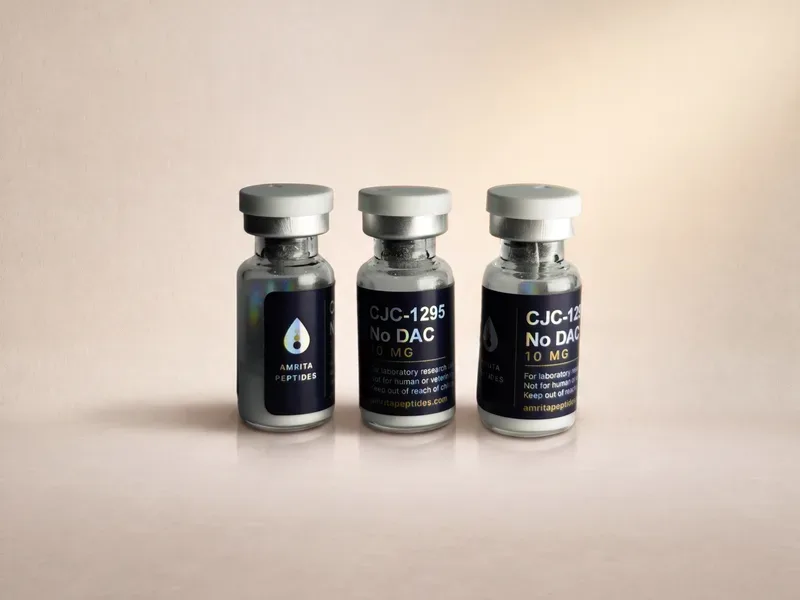
Buy CJC-1295 No DAC 10 mg research vials in Thailand
CJC-1295 No DAC is the short-acting form of CJC-1295 without the Drug Affinity Complex, a synthetic growth-hormone-releasing hormone (GHRH) analogue also sold as Modified GRF 1-29 (Mod GRF 1-29); it is not the long-acting "CJC-1295 with DAC". We stock it as lyophilised powder in 10 mg vials, sold singly or in 5- and 10-vial packs (current baht prices are shown in the size selector). Vials are stocked in Bangkok and dispatched the same day after manual confirmation, with free tracked delivery to Bangkok, Phuket, Chiang Mai and every other Thai province in about 2–3 days. Order by sending the cart message on WhatsApp, LINE or Telegram. Laboratory research use only; not a medicine, supplement, or performance product.
Structurally it is the GHRH(1-29) active fragment with four amino-acid substitutions that resist enzymatic breakdown, studied as a pituitary GHRH-receptor agonist in growth-hormone axis, somatotroph signalling, and endocrine pharmacokinetics research. The published evidence for the no-DAC form is largely preclinical and early-phase. For how it differs from ipamorelin and tesamorelin, see growth hormone secretagogues compared.
Quick facts
- Product
- CJC-1295 no-DAC (Modified GRF 1-29)
- Parent hormone
- Human GHRH(1-29), the active fragment of the 44-residue hormone
- Substitutions
- D-Ala², Gln⁸, Ala¹⁵, Leu²⁷ versus native GHRH(1-29)
- Molecular weight
- ~3.4 kDa (29 residues, C-terminal amide)
- Identifiers
- CJC-1295 naming is inconsistent across catalogues; identifiers published for the DAC-bearing molecule must not be assumed to describe a no-DAC listing
- Intended use
- laboratory research use only
Explore the sequence and chemical composition.
- Y
- dA
- D
- A
- I
- F
- T
- Q
- S
- Y
- R
- K
- V
- L
- A
- Q
- L
- S
- A
- R
- K
- L
- L
- Q
- D
- I
- L
- S
- R
- NH₂
Hover or focus a residue to see its full name.
Modified GRF 1-29 has D-Ala², Gln⁸, Ala¹⁵ and Leu²⁷ substitutions and a C-terminal amide.
Formula shown for Modified GRF 1-29 without the Drug Affinity Complex (DAC).
How CJC-1295 no-DAC works
GHRH is released from the hypothalamus and binds the GHRH receptor on pituitary somatotroph cells, a Gs-coupled receptor that activates adenylyl cyclase, raises intracellular cAMP, and drives growth-hormone synthesis and release. Native GHRH is a poor research tool because plasma destroys it almost immediately: Frohman and colleagues showed that plasma dipeptidylpeptidase-IV (DPP-IV) clips the first two residues to give the near-inactive GRH(3-44) fragment, with an in-vivo half-life for the intact peptide measured at 6.8 minutes (Frohman, J Clin Invest, 1986).
Modified GRF 1-29 is the engineering answer to that problem. The same group demonstrated that a D-amino-acid substitution at position 1 or 2 blocks DPP-IV hydrolysis outright (Frohman, J Clin Invest, 1989), which is precisely what the D-Ala² substitution does here; the Gln⁸, Ala¹⁵, and Leu²⁷ changes close off deamidation, backbone flexibility, and methionine-oxidation pathways respectively. The result is a peptide that survives long enough to be dosed reproducibly but still clears within minutes — so in study models it reinforces the pituitary's own pulsatile GH rhythm rather than holding GH continuously elevated.
The DAC distinction is the important one. The Drug Affinity Complex is a maleimide group that covalently tethers the peptide to circulating serum albumin. Adding it produces a fundamentally different pharmacokinetic molecule — a measured half-life of 5.8 to 8.1 days (Teichman, J Clin Endocrinol Metab, 2006) versus the minutes-range clearance of the no-DAC form. Same tetrasubstituted backbone, different research question entirely.
Key research findings
- The tetrasubstituted hGRF(1-29) backbone used in the no-DAC form was characterised alongside its albumin bioconjugates, which showed enhanced in-vitro stability against dipeptidylpeptidase-IV and were bioactive in a GH-secretion assay in cultured rat anterior pituitary cells (Jetté, Endocrinology, 2005).
- Plasma degradation of native GHRH proceeds through a single-step DPP-IV cleavage at the 2–3 bond, and D-amino-acid substitution at position 1 or 2 prevented that hydrolysis — the mechanistic basis for the D-Ala² modification (Frohman, J Clin Invest, 1989).
- In healthy adults, the DAC-bearing analogue raised mean plasma GH 2- to 10-fold for six days or more with an estimated half-life of 5.8–8.1 days, illustrating how large the DAC-versus-no-DAC pharmacokinetic gap is (Teichman, J Clin Endocrinol Metab, 2006).
Research applications
- Pulsatile growth-hormone release and somatotroph signalling models
- GHRH-receptor binding, cAMP response, and Gs-coupling assays
- Comparative pharmacokinetic work contrasting short-acting and DAC-bound GHRH analogues
- Peptide-stability and DPP-IV-resistance studies of substituted analogues
- Combined GHRH-analogue / GHRP secretagogue receptor-convergence models alongside ipamorelin
- Endocrine axis comparisons with other GHRH-family analogues such as tesamorelin
Study parameters reported in literature
Short-acting GHRH analogues are administered frequently in reported protocols precisely because they clear quickly — the opposite of the DAC-bound form, which appears in the literature at weekly or twice-weekly intervals. This is a descriptive summary of parameters reported in cited research, not a recommendation for use. To model concentrations for a defined protocol, use the CJC-1295 no-DAC peptide calculator.
Reconstitution & storage
- Solvent
- Bacteriostatic water — standard for lyophilised research peptides
- Mixing
- Add solvent down the vial wall and swirl gently until dissolved; do not shake
- Storage
- Refrigerated (2–8 °C) after reconstitution, in common laboratory practice
- Use within
- Roughly 3–4 weeks once reconstituted
- Freeze / light
- Keep lyophilised powder frozen or cold, sealed, and protected from light
These are common laboratory handling conventions for lyophilised peptides, not preparation instructions. In Thailand's heat and humidity, protect vials from ambient temperature swings during storage and courier handling, and minimise time spent at room temperature when handling.
Selected research
- Rapid enzymatic degradation of growth hormone-releasing hormone by plasma in vitro and in vivo to a biologically inactive product cleaved at the NH2 terminus — J Clin Invest, 1986
- Dipeptidylpeptidase IV and trypsin-like enzymatic degradation of human growth hormone-releasing hormone in plasma — J Clin Invest, 1989
- Human growth hormone-releasing factor (hGRF)1-29-albumin bioconjugates activate the GRF receptor on the anterior pituitary in rats: identification of CJC-1295 as a long-lasting GRF analog — Endocrinology, 2005
- Prolonged stimulation of growth hormone (GH) and insulin-like growth factor I secretion by CJC-1295, a long-acting analog of GH-releasing hormone, in healthy adults — J Clin Endocrinol Metab, 2006 (the DAC-bearing form)
- Pulsatile secretion of growth hormone (GH) persists during continuous stimulation by CJC-1295, a long-acting GH-releasing hormone analog — J Clin Endocrinol Metab, 2006
- Browse all indexed CJC-1295 and GHRH-analogue literature on PubMed
Related compounds
- Ipamorelin — a selective pentapeptide ghrelin-receptor (GHS-R1a) agonist. It is studied alongside GHRH analogues because the two act on different receptors on the same somatotroph cells, making the pair a standard model for receptor-convergence research.
- Tesamorelin — another stabilised GHRH(1-44) analogue, and the one member of this family with a substantial registered clinical trial record; useful as a comparator when the research question concerns GHRH-analogue evidence quality.
- Bacteriostatic water — the standard diluent used to reconstitute lyophilised research peptides.
See also: growth hormone secretagogues compared and more growth-hormone-axis compounds.
CJC-1295 no-DAC FAQ
What is the difference between CJC-1295 no-DAC and CJC-1295 with DAC?
They share the same tetrasubstituted GHRH(1-29) backbone, but DAC (Drug Affinity Complex) is a maleimide group that covalently binds the peptide to circulating serum albumin, which drastically slows clearance. The DAC-bearing form has a measured half-life of 5.8–8.1 days (Teichman, JCEM, 2006); the no-DAC form clears in the minutes range. They behave as different compounds in a study design, so a protocol that specifies one cannot substitute the other.
Why is CJC-1295 no-DAC also called Mod GRF 1-29?
Native GHRH is 44 amino acids and its active fragment is residues 1–29 (GRF 1-29). This compound is that fragment modified at four positions — D-Ala², Gln⁸, Ala¹⁵, Leu²⁷ — hence "Modified GRF 1-29". "CJC-1295 no-DAC" and "Mod GRF 1-29" refer to the same molecule, which is a frequent source of catalogue confusion.
What evidence level supports CJC-1295 no-DAC?
Largely preclinical and early-phase. The peptide-chemistry and DPP-IV-resistance work is well documented, and the published human pharmacokinetic data in this family is predominantly for the DAC-bearing analogue and for tesamorelin, not for the no-DAC form specifically. There are no human-outcome claims associated with this product.
What do the study parameters on this page represent?
They record the frequencies, routes, and amounts reported for short-acting GHRH-analogue studies and distinguish them from DAC-bound protocols. They describe cited study designs rather than recommending use of the listed material, which is not intended for humans or animals.
How should CJC-1295 no-DAC be stored, especially in Thailand?
Keep the lyophilised powder frozen or cold, sealed, and out of direct light. Once reconstituted with bacteriostatic water it is typically refrigerated at 2–8 °C in common laboratory practice. In Thailand's heat and humidity, minimise time at ambient temperature during handling and delivery.
Is CJC-1295 no-DAC legal to buy for research in Thailand?
It is offered strictly for laboratory research use only, not for human or veterinary use. An RUO label does not determine legal status; researchers should check current Thai FDA information for the specific product and activity. Tracked delivery is available nationwide after order confirmation.
What should be confirmed before using this material in a protocol?
Confirm that the item is labelled as standalone no-DAC material rather than a DAC version or a blended product, and compare the stated sequence with the sequence required by the protocol. Consistent naming is a useful catalogue check, but it does not independently verify the contents of a vial.
Are the product images photographs of the exact vial shipped?
No. Images are illustrative. Confirm the current label, form, and packaging details when they matter to a protocol.
Compliance note
CJC-1295 no-DAC is supplied for laboratory research use only. It is not for human or veterinary use, and it is not intended to diagnose, treat, cure, or prevent any disease. All findings referenced above are the results of specific published studies, not claims about this product.
Helpful resources
Related products
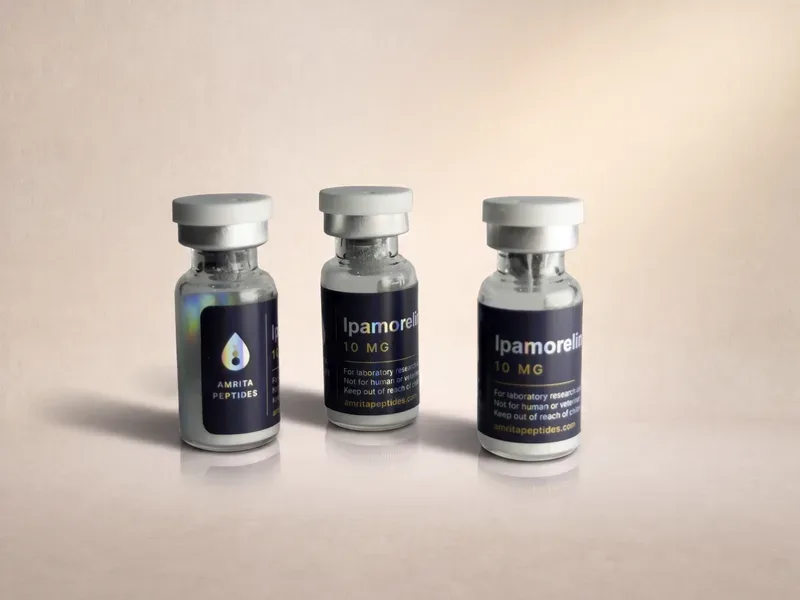
Ipamorelin
Molecular formula: C38H49N9O5
A small, selective growth-hormone releaser — it caught researchers' attention because it leaves cortisol largely untouched.
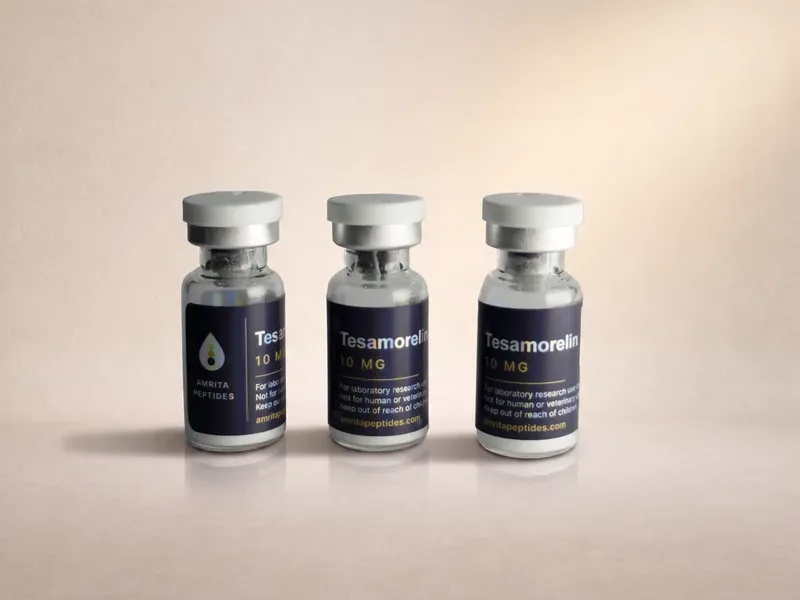
Tesamorelin
Molecular formula: C221H366N72O67S
A stabilised copy of the full growth-hormone-releasing hormone, and one of the few tested in large human trials, including on belly fat.
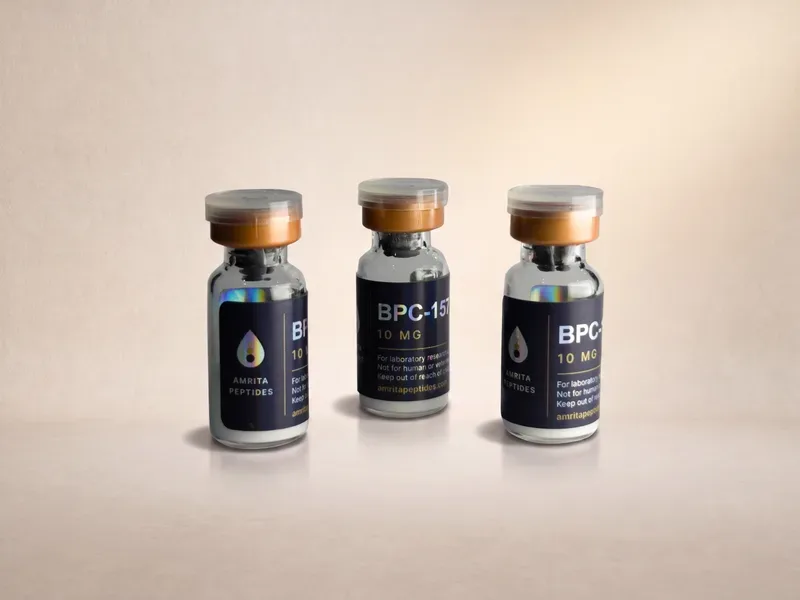
BPC-157
Molecular formula: C62H98N16O22
Probably the best-known recovery peptide — a 15-amino-acid fragment of a stomach protein, researched for how tendons, ligaments and the gut heal.
฿1,900
Added to cart. Research use only.