MOTS-C in Thailand
From ฿3,200 · 40 mg
A peptide made by the mitochondria rather than the main genome, researched for its links to exercise, insulin sensitivity and ageing.
Choose size
Added to cart. Choose another size or open your cart when ready.
For laboratory research use only. Not for human or veterinary use.
Delivery & ordering
- Ships from
- Bangkok, Thailand
- Coverage
- Thailand only — every province
- Dispatch
- Same-day dispatch
- Delivery time
- 2–3 days nationwide
- How to order
- Cart message by WhatsApp, LINE or Telegram
- Payment
- PromptPay, Thai bank transfer, Crypto
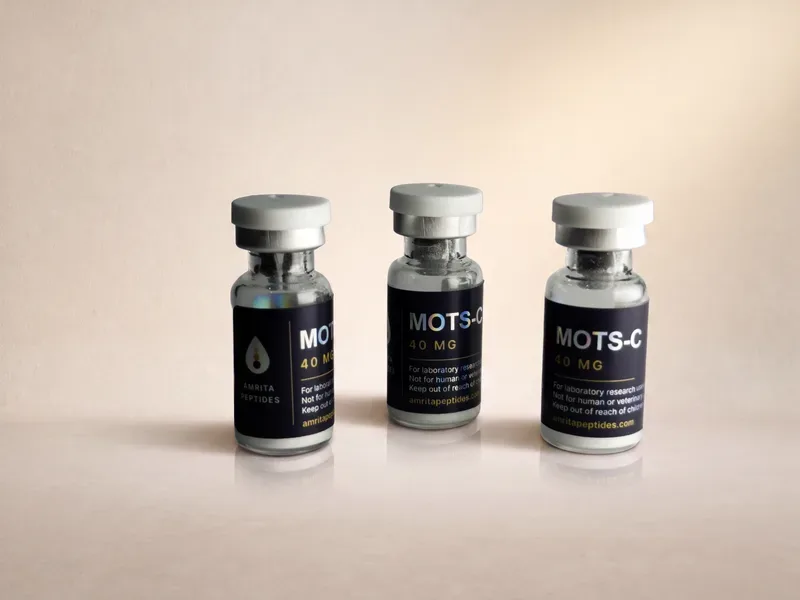
MOTS-c research peptide in Thailand
MOTS-c is a 16-amino-acid mitochondrial-derived peptide encoded inside the mitochondrial 12S rRNA gene, studied in preclinical models of AMPK activation, insulin sensitivity, metabolic homeostasis, and exercise- and age-related decline. It was first characterised by Changhan David Lee and Pinchas Cohen at USC, and it is one of the reference tools for research into how mitochondria signal back to the nucleus.
This listing is for laboratory research use only. The MOTS-c evidence base is almost entirely preclinical — cell culture and mouse models — with no established human protocols; it is not a medicine, supplement, or metabolic product.
Quick facts
- Product
- MOTS-c (mitochondrial open reading frame of the 12S rRNA type-c)
- CAS
- 1627580-64-6
- Molecular weight
- ~2.17 kDa
- Origin
- Encoded in mitochondrial DNA, not the nuclear genome
- Form
- Lyophilised powder, sealed vial
- Intended use
- laboratory research use only
Explore the sequence and chemical composition.
- Met
- Arg
- Trp
- Gln
- Glu
- Met
- Gly
- Tyr
- Ile
- Phe
- Tyr
- Pro
- Arg
- Lys
- Leu
- Arg
Hover or focus a residue to see its full name.
A 16-residue mitochondrial-derived peptide.
How MOTS-c works
Unlike almost every other peptide in a research catalogue, MOTS-c is not transcribed from the nuclear genome — it is read out of an open reading frame hidden inside the mitochondrial 12S rRNA gene. Under metabolic stress it moves out of the mitochondrion into the cytoplasm, where the published mechanism runs through the folate–methionine one-carbon cycle: MOTS-c inhibits the enzyme MTHFD2, purine biosynthesis slows, the intermediate AICAR accumulates, and rising AICAR switches on AMPK — the same energy-sensing kinase engaged by aerobic exercise and by metformin.
A second arm of the mechanism is transcriptional. Kim and colleagues showed that under glucose restriction and oxidative stress MOTS-c translocates further, into the nucleus, where it associates with antioxidant response elements and works with NRF2 to drive stress-defence and metabolic genes. That combination — a mitochondrially encoded peptide directly regulating nuclear transcription — is why the literature describes MOTS-c as a retrograde signal rather than a conventional hormone. These are findings of specific published studies, not outcomes attributed to this product.
Key research findings
- In mice, MOTS-c targeted skeletal muscle and inhibited the folate cycle to activate AMPK; treatment prevented age-dependent and high-fat-diet-induced insulin resistance as well as diet-induced obesity (Lee, Cell Metabolism, 2015).
- Under metabolic stress, MOTS-c translocated from the mitochondria to the nucleus, bound antioxidant response elements, and upregulated stress-response genes including HO-1 and NQO1 via NRF2 in an AMPK-dependent manner (Kim, Cell Metabolism, 2018).
- Exercise induced endogenous MOTS-c expression in human skeletal muscle and circulation, and treatment improved treadmill performance in young, middle-aged, and older mice, including when started late in life (Reynolds, Nature Communications, 2021).
Research applications
- AMPK activation and cellular energy-sensing pathway studies
- Insulin sensitivity, glucose uptake, and diet-induced obesity models
- Mitochondrial retrograde signalling and mitochondria-to-nucleus communication
- Exercise-mimetic pharmacology, benchmarked against AICAR and other AMPK activators
- Ageing, healthspan, and skeletal-muscle homeostasis research
- Folate–methionine and one-carbon metabolism investigation
Study parameters reported in literature
No human protocols are established for MOTS-c, so the figure above is a reference-scale estimate rather than a trial-derived range. Published rodent work used roughly 5 mg/kg/day for short glucose-tolerance experiments and 0.5 mg/kg/day over eight weeks for chronic obesity models (Lee, Cell Metabolism, 2015), with 5–15 mg/kg daily or intermittent regimens in the ageing and exercise work (Reynolds, Nature Communications, 2021). This is a summary of parameters as reported in research references, not recommendations for use. To model concentrations for a defined protocol, use the MOTS-c peptide calculator.
Reconstitution & storage
- Solvent
- Bacteriostatic water — standard for lyophilised research peptides
- Mixing
- Add solvent down the vial wall and swirl gently until dissolved; do not shake
- Storage
- Refrigerated (2–8 °C) after reconstitution, in common laboratory practice
- Use within
- About four weeks once reconstituted
- Freeze / light
- Keep lyophilised powder frozen or cold, sealed, and protected from light
These are common laboratory handling conventions, not preparation instructions. In Thailand's heat and humidity, the practical risk is ambient exposure — minimise time out of cold storage during handling and courier transit, and keep vials out of direct sunlight.
Selected research
- The mitochondrial-derived peptide MOTS-c promotes metabolic homeostasis and reduces obesity and insulin resistance — Cell Metabolism, 2015
- The Mitochondrial-Encoded Peptide MOTS-c Translocates to the Nucleus to Regulate Nuclear Gene Expression in Response to Metabolic Stress — Cell Metabolism, 2018
- MOTS-c is an exercise-induced mitochondrial-encoded regulator of age-dependent physical decline and muscle homeostasis — Nature Communications, 2021
- MOTS-c, the Most Recent Mitochondrial Derived Peptide in Human Aging and Age-Related Diseases — Int J Mol Sci, 2022 (review)
- Browse all indexed MOTS-c literature on PubMed
Related compounds
- NAD+ — the central redox coenzyme and sirtuin substrate; studied alongside MOTS-c wherever mitochondrial energy metabolism and ageing intersect, though through a coenzyme rather than a signalling-peptide mechanism.
- SS-31 — a mitochondria-targeted tetrapeptide studied for its binding to cardiolipin in the inner mitochondrial membrane; a structural counterpart to MOTS-c's transcriptional and AMPK-mediated route.
- Pinealon — the Khavinson tripeptide Glu-Asp-Arg, also listed in the mitochondrial hub. Its published work measures reactive-oxygen-species build-up and cell survival in stressed neuronal cultures, so it addresses oxidative damage rather than MOTS-c's AMPK and metabolic signalling.
- Bacteriostatic water — the standard diluent used to reconstitute lyophilised research peptides.
See also: mitochondrial research compounds and more mitochondrial and cellular research compounds.
Buying MOTS-C in Thailand
MOTS-C is stocked in Bangkok as 40 mg vials, sold singly or in packs of 5 or 10. Prices are in Thai baht and include tracked delivery anywhere in Thailand. 10 × 40 mg vials work out at ฿2,500 a vial, 22% less than a single 40 mg vial.
| Option | Price | Per vial |
|---|---|---|
| 1 × 40 mg vial | ฿3,200 | ฿3,200 |
| 5 × 40 mg vials | ฿13,600 | ฿2,720 |
| 10 × 40 mg vials | ฿25,000 | ฿2,500 |
Dispatch and delivery
Same-day dispatch from Bangkok once your order is confirmed, by tracked courier. Typical timing:
- Bangkok
- same-day or next-day dispatch after confirmation
- Pattaya and the Eastern Seaboard
- tracked overnight where courier timing allows
- Phuket and the South
- usually 1–2 days after dispatch
- Chiang Mai and the North
- usually 1–2 days after dispatch
- Hua Hin, Koh Samui, and other provinces
- tracked nationwide courier delivery
How to order
Add a size to the cart and send the order message it writes on WhatsApp, LINE or Telegram. We reply with stock, the total and payment details (PromptPay, Thai bank transfer or Crypto). Nothing is charged on this website.
MOTS-c FAQ
What kind of evidence supports MOTS-c?
Preclinical evidence, almost entirely. The foundational papers are cell-culture experiments and mouse models published in Cell Metabolism and Nature Communications; human data is limited to observational work showing that endogenous MOTS-c rises with exercise and declines with age. There are no established human dosing protocols and no human-outcome claims associated with this product.
Why is MOTS-c described as mitochondrial-derived?
Because it genuinely is. The MOTS-c open reading frame sits inside the mitochondrial 12S rRNA gene rather than in nuclear DNA, which makes it one of the first characterised mitochondrial-derived peptides (MDPs). That origin is the reason researchers use it to study retrograde signalling — information flowing from the mitochondrion back to the nucleus.
Why is MOTS-c called an exercise mimetic in the literature?
Because it converges on AMPK, the same energy-sensing kinase activated by aerobic training. Reynolds and colleagues reported that exercise induces endogenous MOTS-c in human muscle and circulation, and that treatment improved physical performance in mice across age groups. "Exercise mimetic" is a mechanistic shorthand used in the papers, not a performance claim about this product.
What do the study parameters on this page represent?
They record the body-weight-based amounts, intraperitoneal route, and schedules used in the cited mouse studies. They describe preclinical study designs rather than recommending use of the listed material, which is not intended for humans or animals.
How should MOTS-c be stored, especially in Thailand?
Keep the lyophilised powder frozen or cold, sealed, and out of direct light. Once reconstituted with bacteriostatic water it is typically refrigerated at 2–8 °C and used within about four weeks. Thailand's ambient heat is the main variable, so minimise time at room temperature during handling and delivery.
Is MOTS-c legal to obtain for research in Thailand?
It is offered strictly for laboratory research use only, not for human or veterinary use. An RUO label does not determine legal status; researchers should check current Thai FDA information for the specific product and activity. Tracked delivery is available nationwide after order confirmation.
Where is this MOTS-c sourced and what should be confirmed on arrival?
It is sourced from established suppliers, stocked in Bangkok, and dispatched within Thailand. Product images are illustrative rather than photographs of the exact vial shipped, so confirm the current label, vial strength, and packaging details when they matter to a protocol.
Compliance note
MOTS-c is supplied for laboratory research use only. It is not for human or veterinary use, and it is not intended to diagnose, treat, cure, or prevent any disease. All findings referenced above are the results of specific published studies, not claims about this product.
Helpful resources
Related products

GHK-Cu
Molecular formula: C14H23CuN6O4+
A copper peptide found naturally in the body, best known from skin research, where it is looked at for collagen and tissue remodelling.
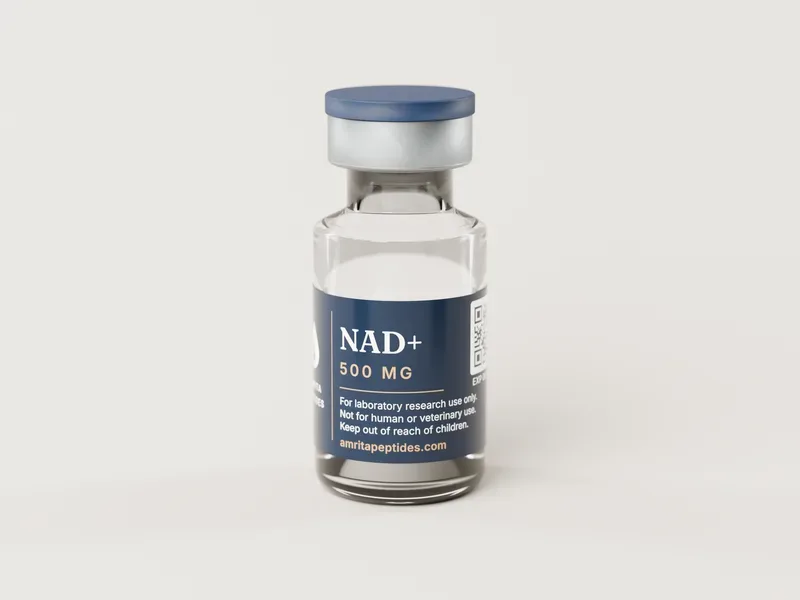
NAD+
Molecular formula: C21H27N7O14P2
Not a peptide, but the coenzyme every cell uses to turn food into energy — levels fall with age, which puts it at the centre of longevity research.
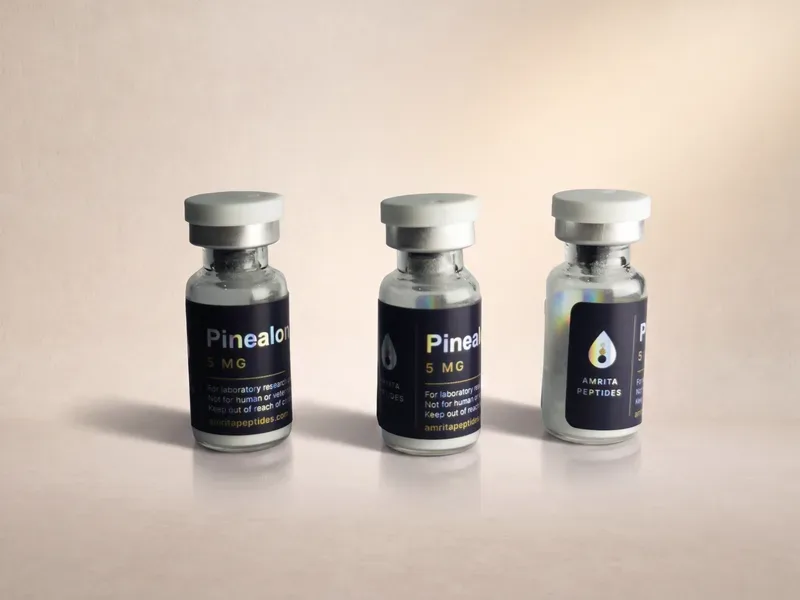
Pinealon
Molecular formula: C15H26N6O8
A tiny three-amino-acid peptide from Russian "bioregulator" research, looked at for how nerve cells cope with oxidative stress and ageing.
฿3,200
Added to cart. Research use only.